Master's project pitch
LungLens
Bridging the Diagnostic Gap with a 6-Model AI Ensemble
An educational translation layer designed to combat radiologist burnout and bridge the patient health literacy gap — not a medical device, not a diagnosis.
Educational use only · Discuss all findings with a qualified clinician
The clinical gap
Why patients leave the reading room more confused than informed
Radiology excellence does not automatically translate into patient understanding. LungLens targets the friction between expert interpretation and everyday health literacy.
Critical report turnaround
Backlogs stretch turnaround times. Delayed or dense reports leave patients waiting without actionable context they can safely discuss with care teams.
Impenetrable jargon
Terms like “opacification” or “consolidation” rarely map to what patients feel. Without translation, reports become documents—not conversations.
Radiologist fatigue & search satisfaction
High volume and cognitive load increase satisfaction-of-search errors—stopping once something is found while subtler patterns may be missed.
System architecture
Full-stack pipeline built for parallel inference
The browser never runs ML. Next.js orchestrates consent-aware UX. FastAPI owns preprocessing, ensemble fusion, and optional LLM synthesis server-side.
Next.js frontend
Gate · upload · results
FastAPI BFF
Auth · validate · proxy
Parallel inference
PyTorch · Keras · tabular
Five vision specialists
Model 1
ResNet-50
Baseline convolutional detector for multi-label thoracic patterns.
Model 2
ResNet-152V2
Deep residual backbone with strong validation accuracy on holdout CXR.
Model 3
DenseNet-121
Dense connectivity + Grad-CAM interpretability for educational overlays.
Model 4
Swin-T
Hierarchical vision transformer capturing long-range lung field context.
Model 5
DenseNet-121 Expansion
Augmented training pipeline extending Model 3 capacity.
Model 6 · Tabular
COPD risk screening vector
When the vision gate requires clinical context, a 10-feature questionnaire vector (age, fever, cough duration, smoking history, breathing difficulty, and related signals) feeds a dedicated tabular model. Its output fuses with the vision ensemble for COPD-oriented educational risk framing — still non-diagnostic, still for discussion with clinicians.
Product experience
From ensemble inference to patient-ready education
LungLens turns parallel model outputs into a structured results dashboard, optional clinical intake when the gate requires it, and a plain-language educator summary — all framed for discussion with clinicians, not as a diagnosis.
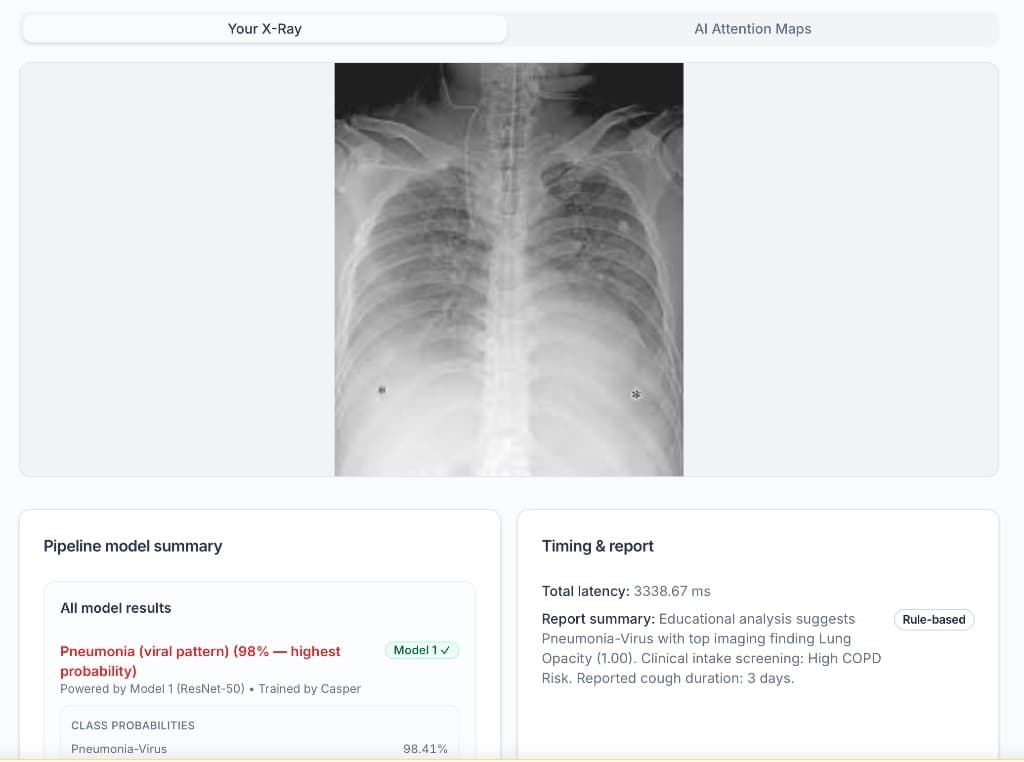
After upload, users review the original film alongside Model 1 (ResNet-50) probabilities, fused findings such as lung opacity, and a rule-based report summary that can incorporate questionnaire-driven COPD screening — with a separate tab for AI attention maps (Grad-CAM).
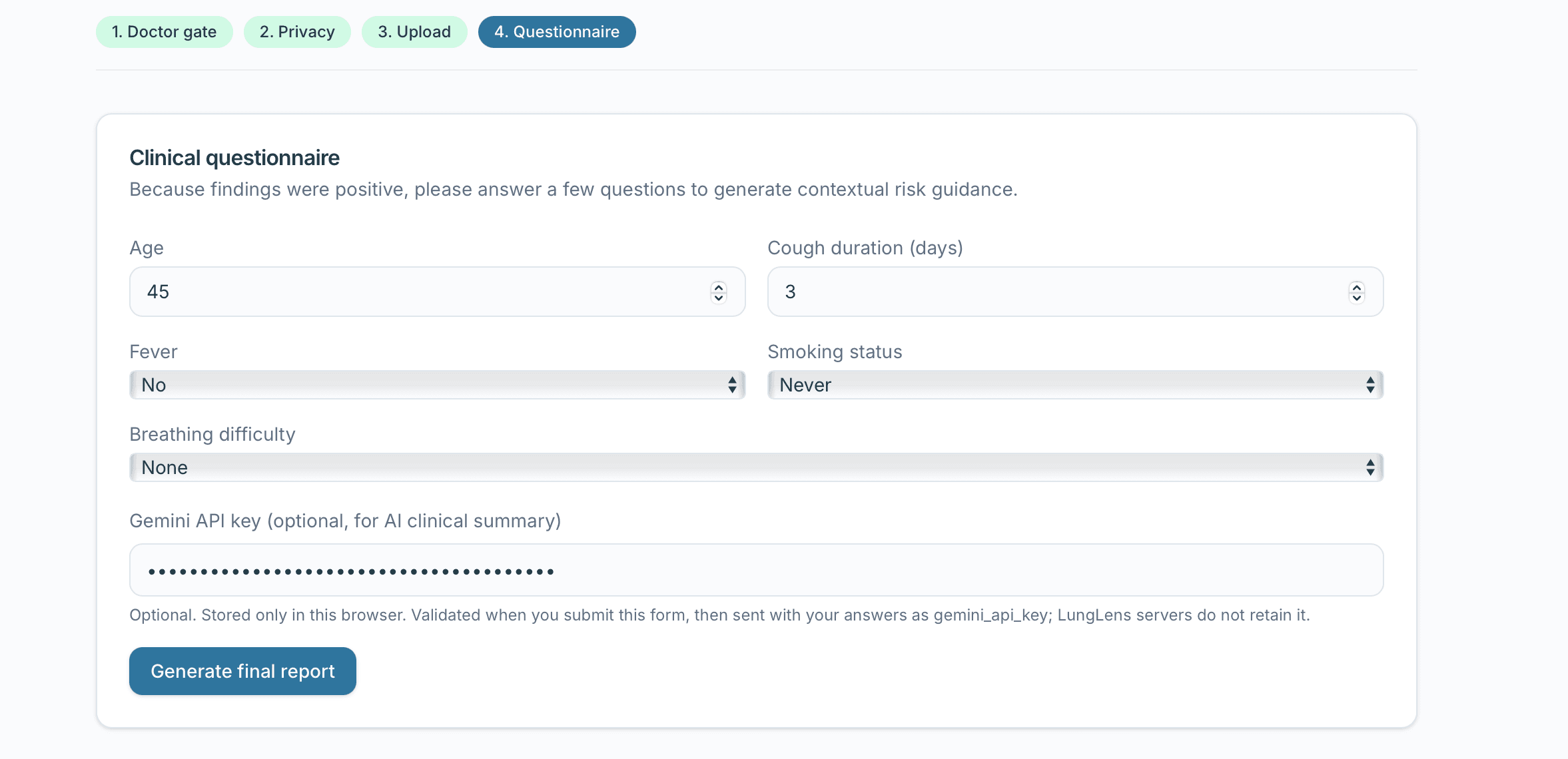
When imaging findings trigger the clinical path, a short intake (age, cough duration, fever, smoking, breathing difficulty) feeds the tabular COPD risk model. An optional BYOK Gemini key is validated on submit and never stored on LungLens servers.
Synthesized from ensemble scores and questionnaire context — educational only.

Interpretability in the narrative
The educator ties radiographic patterns such as lung opacity to the patient's stated symptoms (for example, cough duration and smoking history) so families can prepare questions for appointments. It does not replace radiologist interpretation or clinical judgment.
Use the AI Attention Maps tab on the results screen to visually verify that convolutional models attend to lung fields rather than labels, tubes, or hardware — the same transparency goal as Grad-CAM in the research pipeline.
Screenshots reflect a representative educational run (e.g. Pneumonia-Virus pattern with optional COPD screening). Outcomes vary by image quality, gate routing, and whether a Gemini key is supplied.
Holdout validation
Performance metrics on validation splits
Reported figures reflect internal holdout evaluation for research demonstration — not clinical deployment claims.
94.0%
Ensemble consensus accuracy
88.6%
Model 2 (ResNet) validation accuracy
92.0%
Model 3 (DenseNet) precision
Meet the architects
Research team & model ownership
Charles Tsoi
Casper Lee
Edward Choi
Dicky Ng
Jenna Tse
Ready to see the ensemble in action?
Walk through the live gate, upload flow, attention overlays, and educator summary — the same path your audience can try after this pitch.
Start the Analysis